
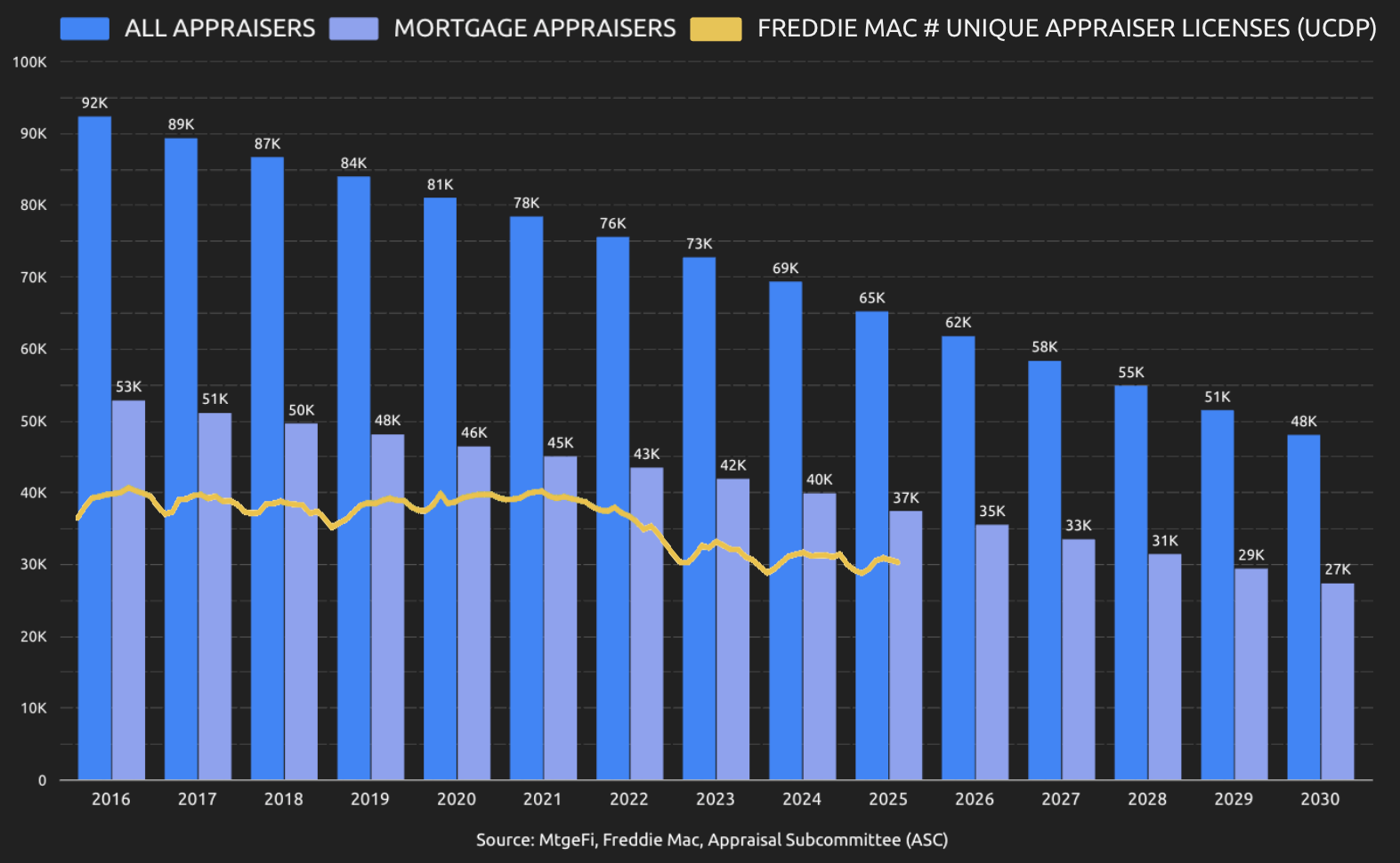
This article looks at residential appraiser trends over the last 10 years, and projects capacity for the next 5 years. A previous article concluded that there are ~65,000 active real estate appraisers operating across the US, as of June 2025.
Using the same methodology to identify unique appraisers we estimate there were ~92,000 real estate appraisers in US in 2016. In 10 years the number of appraisers has fallen by 27,000, or 29.4%.
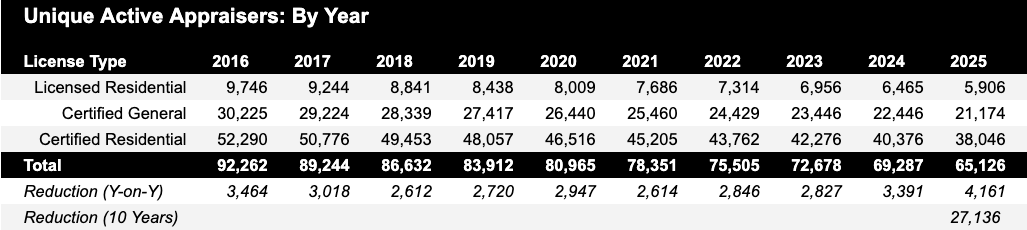
The rate of reduction differs by (primary) license type, but the largest reduction has been with Licensed (Residential-Only) Appraisers, at 39.4%.
Residential Appraiser Trends – Field Assignments
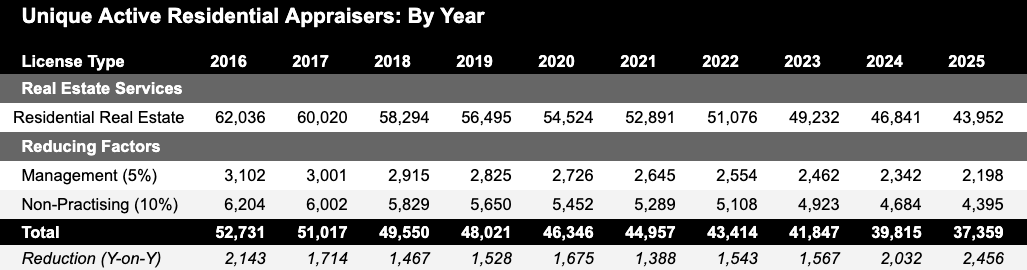
In June 2025 we estimated there are ~38,000 active appraisers in the US completing residential appraisals in-the-field on a weekly basis to support mortgage lending and other forms of housing finance. In 2016 that number was estimated to be ~53,000, a reduction of 15,000 appraisers, or 28.3%.
The Next 5 Years
In the next 2 years major changes will impact the residential appraisal profession, most notably the introduction the new Uniform Appraisal Dataset (UAD) 3.6 and redesigned Uniform Residential Appraisal Report (URAR).
UAD 3.6 starts Limited Production September 8, 2026, concluding January 26, 2026. After that Broad Production runs through to mandatory use by November 2, 2026.
Residential Appraiser Scenarios
Scenario – Steady State
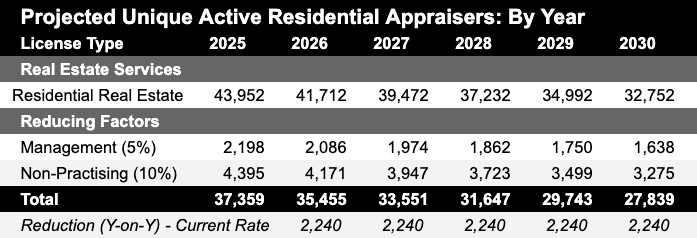
For the past 2 years, the (weighted) average decrease in active residential appraisers is 2,240 per year. Assuming this rate remains the same, under this scenario, the projected number of active appraisers completing residential appraisals in-the-field will fall below 30,000 in 2029.
It is estimated that ~80% of residential appraisers actively work for lenders originating first mortgages.
Scenario – Accelerated
The actual rate of appraisers leaving the profession has increased materially in each of the last 3 years. This could reflect a trend where appraisers choose not to renew licenses until mortgage volume increases. If appraisers do return to the profession they will have to adapt to UAD 3.6 and the new URAR.
If this trend is sustained the number of active appraisers completing residential appraisals in-the-field falls below 30,000 as soon as 2026.
Residential Appraiser Trends Conclusions
Given these recent trends, the number of active residential appraisers supporting first mortgages originations could fall below the actual number of appraisers currently submitting to the Uniform Collateral Data Portal (UCDP) for the first time ever.
While individual appraisers can undoubtably complete more appraisals, this places hard limits on the total supply of appraisals, and the ability of the industry to absorb excess demand in a lowering rate environment.

Not seeing what you need? Have questions?
Request more information or a specific report from MtgeFi.com
Data Sources & Analysis
The Appraisal Subcommittee (ASC)
The Appraisal Subcommittee (ASC) oversees the real estate appraisal regulatory framework for federally related transactions. The ASC is a subcommittee of the Federal Financial Institutions Examination Council (FFIEC).
The ASC provides the AMC Registry to search for Appraisal Management Companies and the Appraiser Registry to search for Appraisers, based on State credentials. The Appraiser Registry collates data nationally from state appraiser licensing boards.
Freddie Mac Appraiser Capacity
Freddie Mac publishes a monthly Appraiser Capacity report that provides data on the volume of appraisals being completed and the number of appraisers completing them.
In June 2025 this showed just over 30,000 active appraiser licenses being used to submit to the Uniform Collateral Data Portal (UCDP) monthly. Additionally, the data is for all appraisal report types submitted to UCDP, not just Fannie Mae URAR 1004 and Freddie Mac URAR 70 ‘traditional appraisal’ forms.
Data Analysis
The number of unique appraisers – by license type, active year, and expiring year – differs marginally from previous reports to be able to apply a consistent baseline and analysis across the 10 years period. The error rate is estimated to be +/- 2%.